



From ancient aura to biophotons: discover UPE, the biological light that reveals vitality and connects science, culture and technology of the future
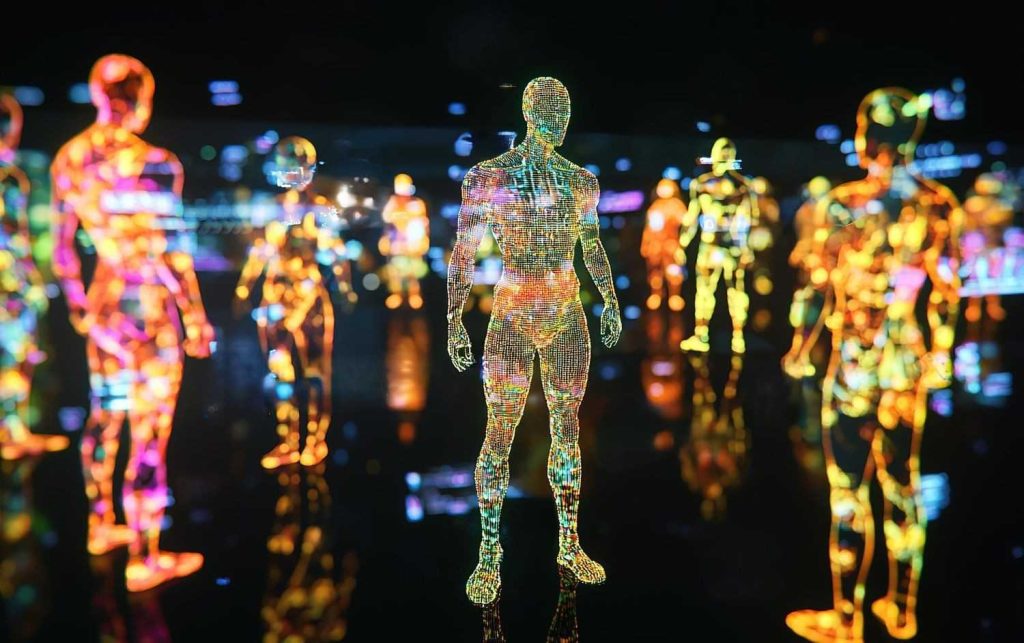
The first representations of bodies surrounded by a luminous halo date back to ancient Greece: this was the so-called ‘aura’, a term which in ancient Greek means ‘breath’. In depictions of philosophers and classical sculptures, sacred figures or those endowed with superior knowledge were often painted with a glow emanating from their heads and shoulders. This concept was not unique to Greece: in Eastern cultures, for example in the Vedas, the aura was described as an envelope of energy surrounding living beings; in the Book of Dzyan, a sacred text attributed to ancient esoteric traditions, there is mention of luminous bodies that reflect spiritual and vital states; and in ancient Egypt, hieroglyphics depict pharaohs and priests surrounded by a halo indicating power, vitality and connection with the universe.
In Christian paintings, the concept of the halo or nimbus continues this tradition: artists such as Raphael, Titian and other Renaissance painters depicted sacred figures with a luminous halo, indicating their holiness and state of inner enlightenment.
Today, thanks to advanced scientific instruments, we can look beyond mythology and art: what for centuries was considered symbolic or spiritual is now confirmed by a real, measurable and quantifiable phenomenon: the emission of ultra-weak biological photons, known as UPE (Ultraweak Photon Emission).
What is the UPE and why is it important?
UPE is a faint light emitted by living beings during their lifetime, which fades away a few moments after death. Unlike the thermal radiation generated by a warm body, UPE is the result of very specific biochemical processes: cellular chemical reactions, the production of free radicals and, above all, energy exchanges in the mitochondria.
Mitochondria, often referred to as the powerhouses of the cell, produce energy in the form of ATP. In this process, some electrons can excite oxygen molecules, which release photons when they return to their ground state. The result is an infinitely weak but significant light: each square centimetre of skin can emit only a few photons per second, an amount imperceptible to the human eye but detectable by sensitive instruments such as photomultipliers and ultra-sensitive CCD cameras.
The Canadian experiment on mice
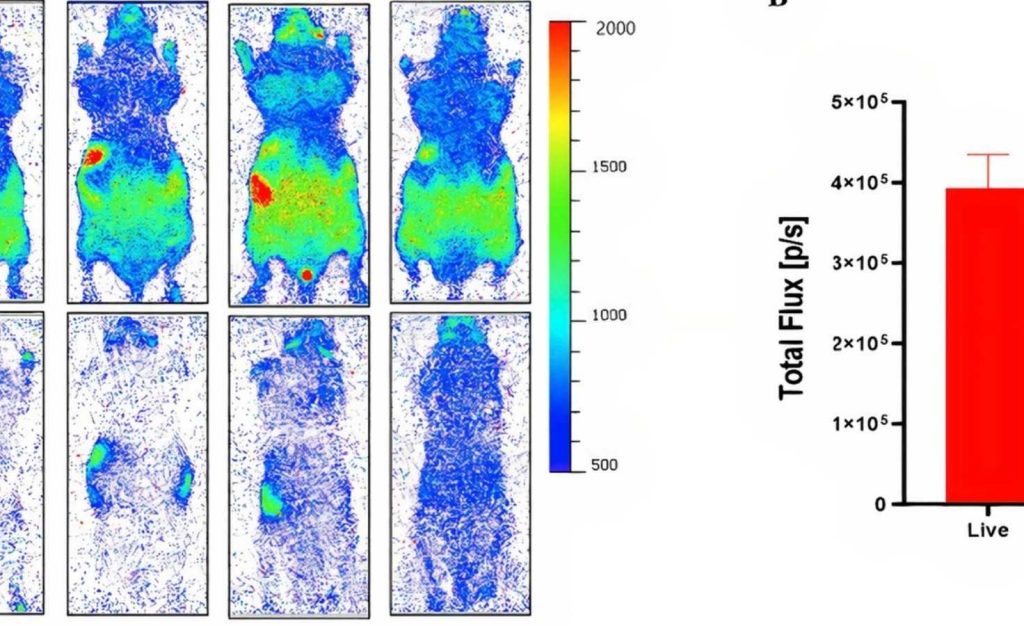
The research team from the University of Calgary and the National Research Council of Canada conducted a pioneering study to observe UPE. Four mice were placed in a dark box, and their light emissions were recorded before and after euthanasia using single-photon-sensitive digital cameras.
To ensure that the light observed was not generated by body heat, the temperature of the box was kept constant and the mice were warmed even after death. The images revealed that:
- Before death: the mice emitted photons from their entire bodies, with greater intensity from their heads, paws and vital organs.
- After death: the light has almost completely disappeared, leaving only a few residual traces.
This clearly demonstrates that UPE is closely linked to metabolic activity and biological vitality.
The biophysics of UPE and the role of mitochondria
Mitochondria not only produce chemical energy, but are also dynamic centres of electrical oscillations and biophotons. These oscillations are related to the circadian rhythm and physiological states of the organism. Electrons excited during oxidation reactions can fall to lower energy levels, emitting photons with wavelengths between 350 and 750 nm, which are only visible using highly sensitive instruments.
Furthermore, the light emitted by mitochondria could play a communicative role within the body: some research suggests that ultra-weak photons transmit signals between cells, influencing metabolic and replicative processes. This introduces the idea that biological light is not just a waste product of metabolism, but a real means of biochemical and biophysical information.
Aura and vital light in world cultures
The aura is not just an artistic or religious concept: in many spiritual traditions, it is considered an indicator of vitality and health. In India, yoga and Ayurveda speak of prana, vital energy that manifests itself as a glow; in China, traditional medicine uses the concept of Qi, which flows along energy meridians; Native American populations observed phenomena of light and colours around shamans during spiritual ceremonies.
These ancient descriptions correspond today to the UPE phenomenon: modern science has confirmed what many cultures had intuited, albeit through symbolic and artistic language.
Advanced experiments on plants, insects and animals
Not only humans emit UPE: all living organisms do.
- Plants: studies on shoots and leaves show photon emission related to photosynthesis, water stress and disease. The light emitted can vary between 10 and 100 photons per second per square centimetre.
- Insects: bees and wasps exhibit light fluctuations linked to muscle and metabolic activity, and this phenomenon can be used to monitor stress and health in hives.
- Animals: migratory birds and small mammals emit UPE variations in relation to emotional state, neurological activity and metabolic processes, opening up possibilities for non-invasive monitoring in behavioural biology.
Links between UPE, consciousness and social networks

Xlife.life, the social network of the future, aims to integrate UPE understanding to create deeper connections between users. Imagine a system capable of reading vital energy, state of well-being and metabolic vitality, enabling social interactions based on energy affinity and biological complementarity.
This technology could facilitate:
- Authentic connections: finding people who not only share common interests, but are also compatible in terms of energy and vitality.
- Professional collaborations: scientists, artists, or related professionals could be connected naturally, accelerating creativity and innovation.
- Emotional support: sharing positive energy could improve psychological and social wellbeing.
Wearable devices for reading the UPE
With advances in technology, miniaturised, non-invasive sensors could detect UPE in real time. Imagine wearable devices that:
- They measure the biological light emitted by the skin.
- They connect data to social platforms to suggest interactions based on energy affinity.
- They monitor health, stress and metabolic vitality.
- They offer real-time feedback to improve lifestyles, concentration and productivity.
These devices would transform the way we perceive health, socialising and collaboration, creating a bridge between biology, technology and social interaction.
Conclusion
UPE represents the invisible light of life, a glow that connects biology, history, culture and technology. From the ancient world of auras and halos to advanced experiments on ultra-weak photons, from the biophysics of mitochondria to future wearable devices, biological light offers a new paradigm for understanding ourselves and connecting with others.
Xlife.life wants to make life more special, not just connecting people, but allowing them to share energy, vitality and awareness. The future of social networks may not only be


Leave a Reply