



BitChat is an offline Bluetooth messaging system that eliminates servers and the cloud, offering truly private conversations between nearby devices. A revolution in decentralised communication.
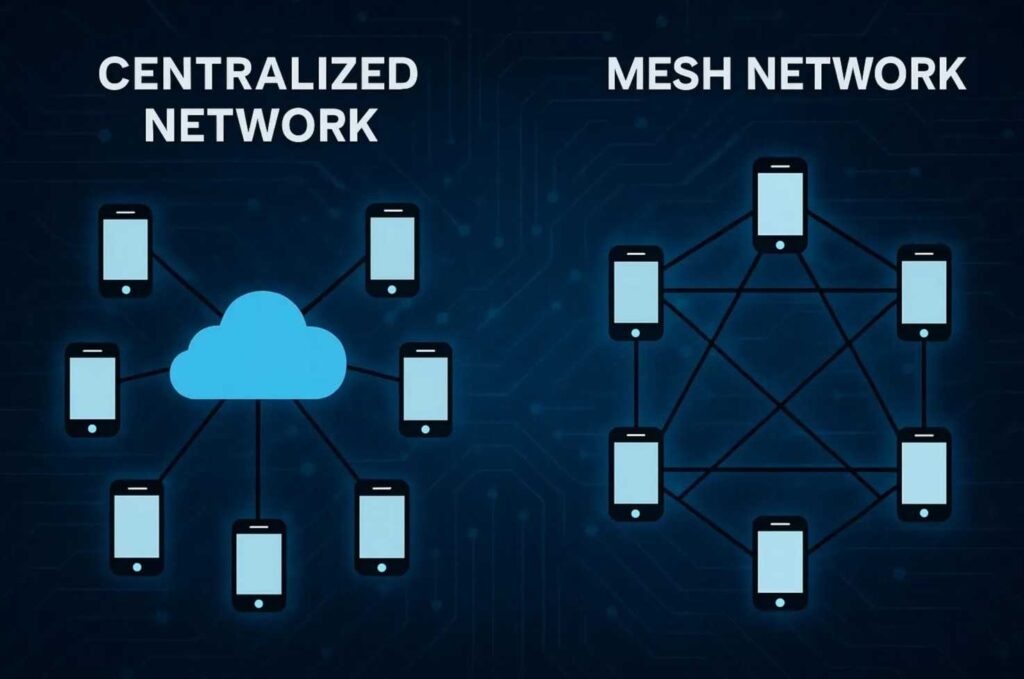
In an age marked by invasive algorithms, massive data collection and increasingly frequent privacy violations, protecting our digital conversations has become a real challenge. Technology has evolved rapidly, but often at the expense of our privacy. What if there were a concrete alternative, already in operation, that showed a different way forward?
An interesting answer comes from Bitchat, a peer-to-peer messaging system via Bluetooth that does not rely on any central server. Messages are exchanged only between physically close devices, without anything being recorded or stored online. In other words, a truly private conversation that exists only between the participants and disappears with them.
What can XLife.life learn?
The XLife.life project was born with a similar vision: to build a decentralised digital ecosystem where users remain the owners of their own data, relationships and content. In this context, taking inspiration from Bitchat makes sense.
Let’s imagine an extension of XLife that allows users, during an event, a gathering, or simply among neighbours, to communicate via local Bluetooth messaging, without relying on the internet. It would be a way to:
- reduce digital tracking,
- increase confidentiality in interactions,
- create a more genuine connection between people who are in the same space.
The tangible benefits of a hybrid approach
Incorporating local peer-to-peer messaging into XLife.life would have numerous advantages:
✅ Zero metadata: no saved history, no servers to attack.
✅ Greater trust: for users who are wary of traditional apps.
✅ Real privacy: messages visible only between the devices involved.
✅ Conscious use: no endless feeds, only essential and temporary communication.
Critical issues to be addressed
Of course, it’s not all straightforward. A peer-to-peer system via Bluetooth presents certain challenges:
- Physical limitation: only works between users who are close to each other.
- Hardware compatibility: some older devices may not handle this mode well.
- Data loss: if devices do not synchronise correctly, you risk losing messages.
- Difficulties in moderation: without centralised storage, it becomes more complicated to intervene on illegal content.
- GDPR compliance: ensuring the right to be forgotten or data portability requires new technical solutions.
One solution: decentralised hybrid
The answer? A hybrid approach: XLife.life could combine local offline messaging for immediate interactions with encrypted, decentralised online messaging for long-distance conversations.
A similar system could be based on:
- End-to-end encryption to protect data in every form,
- Distributed secret sharing to prevent a single node from having access to all data.
- IPFS or Solid networks for storing content without compromising privacy,
- Voluntary audits to verify compliance with privacy regulations without centralising control.
What about moderation?
One of the most sensitive issues remains the management of inappropriate or illegal content. In a decentralised system, community moderation is needed: for example, reporting protocols that allow users to upload encrypted evidence and trigger a distributed, transparent but privacy-respecting intervention.
Conclusion: a new form of digital intimacy
Peer-to-peer technology via Bluetooth, such as that used by Bitchat, shows us that another way of communicating is possible. Not everything has to go through the cloud, servers and algorithmic profiling. Sometimes, the best way to protect privacy is not to generate traceable data from the outset.
For XLife.life, this is an opportunity: not only to innovate, but to radically transform the way we think about communication. Less dependence, more autonomy. Less surveillance, more trust. More humanity.
Follow our blog to find out how decentralised messaging will evolve on XLife.life.
In a more conscious digital future, privacy is not optional. It is a right. And a responsibility.




Leave a Reply